
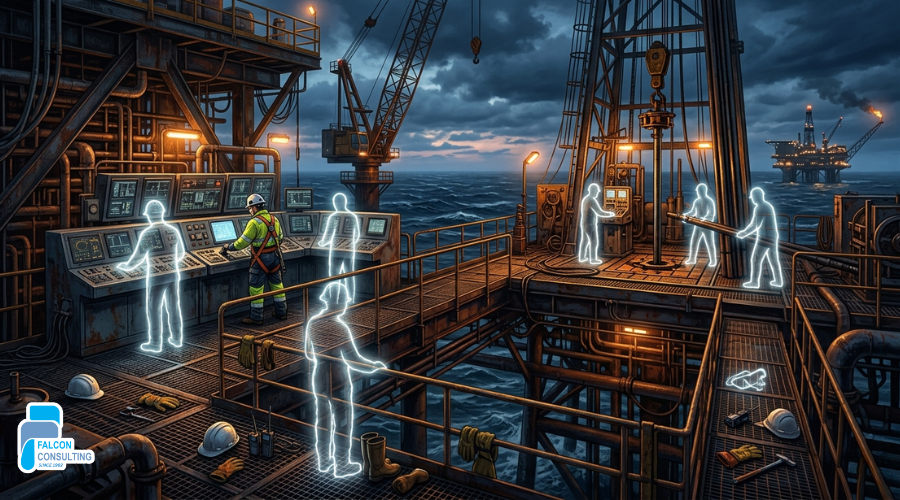
Oil & Gas Hiring challenges are not as straightforward as people think.
The conventional story that is often repeated is that Oil and Gas operators are abandoning the traditional business for renewables, or that Oil and Gas operators are doubling down on traditional business and ignoring the transition to renewables, is just not the story that is playing out inside the organizations that actually have the budgets to make a difference. The story that plays out if you actually track the hiring behaviour among the largest operators in the sector is a lot more interesting and a lot more complex than either of those conventional stories would suggest.
The Oil and Gas operators are not choosing a side; they’re trying to operate two businesses simultaneously.
We spent most of 2025 studying hiring trends among more than 50 energy companies that operate at scale, i.e., those with revenues above $2.6 billion, whose hiring activity represents actual strategic intent.
The data we’ve seen from this exercise warrants a quick pause.
When 72% of the largest players in the industry are ramping up investment in carbon capture, low-carbon fuels, and green infrastructure within the same earnings cycle, this isn’t a trend; this is a structural shift. And when there’s a structural shift, there’s a new type of hire to be made — not someday, but right now.
There’s a big difference between a company that invests in some renewable energy pilots to check a box for investor relations purposes and a company that’s actually investing in renewables at scale. Most of the large operators we’ve looked at have clearly crossed this line. And once you have, your hiring needs are completely different.
You’re no longer hiring environmental specialists to write compliance reports. You’re hiring engineers, project leaders, and commercial specialists who have actually run low-carbon projects from concept to operations. These people are far fewer in number than most companies realize until they start looking for them.
The concept of a “Chief Sustainability Officer” was once a title companies would give someone when they needed someone to give a speech or talk to regulators. This is no longer the case – or, at least, not among the companies that are actually serious about sustainability positioning.
The new executive sustainability roles are not just about speaking in public or talking to regulators, but they do come with real budget authority and direct accountability for decarbonization targets tied to investor expectations. Finding someone who has the operating chops to sit in those meetings and the ESG savvy to lead those discussions is actually hard. Most companies are forced to choose one or the other.
A lot of what’s driving low-carbon strategy in this space has been driven through acquisition, rather than development. It’s a completely rational approach, from a financial perspective, certainly. The issue, though, is that integration, post-M&A, inevitably creates a second-order issue around talent: skills mismatch, critical skill gaps in new tech areas, cultural integration between teams that come from very different operating cultures. It’s a common underestimation.
Green hydrogen, AI-driven engineering, advanced emissions monitoring – these are not just new areas to learn about, they are new areas to think about. They require professionals to think and act effectively within an environment where the process is still being developed. The traditional approach to hiring a highly technical expert and plugging them into an established process is no longer relevant because there is no established process.
Adaptability is no longer a soft skill that is tangentially relevant to the hiring process, but rather a formal hiring criterion for the organizations that are getting this right.
This is often derided as “warm-fuzzy” HR term… if you look at the companies that are having the most success sourcing talent in this tight talent market, you’ll find that they’re the ones with inclusive cultures and a sense of purpose beyond “making shareholders happy.”
Newer technical talent, the folks who will staff these new areas of capability, consider employer brand as part of their decision process. If your corporate brand doesn’t match where you’re really going, you’re not going to win the talent war even before the phone call is made.
The companies who get this right aren’t taking this approach of having a separate team for sustainability hires. The best hires in this space have been people who have a basic understanding of how a refinery or upstream operation works and can apply this knowledge to solving an emissions problem.
Looking for people who have expertise in clean tech and throwing them into an environment where they have no idea how things work creates friction for them. They can’t communicate in the same language as the people they have to work with, and they can’t establish credibility quickly. The hybrid is more difficult to find but is worth the search.
A VP of Operations that is not able to hold a believable conversation about carbon strategy, energy transition risk, or tech investment is no longer just a cultural outlier; he or she is a structural risk. The search brief for such a role absolutely needs to reflect this, not as a “nice to have,” but as a “must have.”
The overwhelming number of search briefs we see still have yet to make this change. The same competencies are still included, with a new bullet point tacked on at the end.
The companies that will thrive in the next five years aren’t the ones who are currently optimizing for this cycle. They’re the ones who are building a workforce that can thrive in multiple energy worlds – people who have enough flexibility to contribute to a traditional refining environment today and a hydrogen-centric environment tomorrow.
That means taking an active approach to pipelining, assessing your internal development capabilities, and working with recruiting firms who truly understand the landscape – not just your organization chart.
Passive candidates, especially technical talent at higher levels, are already researching your firm prior to the first call. If your external brand does not convey a clear energy transition story and a culture that takes technical things seriously, you are losing the evaluation before the conversation even begins. This is not a communications issue; it is a strategy issue.
What do we see when we really examine these trends? What we see is that the oil and gas hiring trends are no longer speculative. They are already being reflected in the actions of the largest oil and gas companies.
The companies that are treating this period as an adjustment, something to manage until the cycle changes, will find themselves playing catch-up. Not just on sustainability credentials, but operational capabilities. The people who are going to be able to navigate this transition are already making career decisions. They are already making those decisions based on what they see.
The next important hire you make is either going to help you get ahead of this issue or it isn’t. There is no neutral. The window to get ahead of this is shorter than most teams recognize.
If you’re hiring for a critical position within this space and traditional channels aren’t working for you, that’s not a pipeline problem; it’s a strategy problem.
We work with energy and oil and gas companies who have hiring needs that are highly specific, not general.
Let’s discuss how this applies to your organization.
BackCorporate Office
1308 & 1309,
72 Corp, Saki Naka Junction,
10 Saki Vihar Road,
Andheri East,
Mumbai 400072
Registered Office
B10 Valmiki,
Next to Bombay College
of Pharmacy,
CST Road, Kalina,
Santacruz East,
Mumbai 400098
Branch Office
Door # 10, First Floor,
AE Block, 7th Street,
Anna Nagar,
Chennai 600040
All © Rights Reserved: Falcon HR Consulting Private Limited.